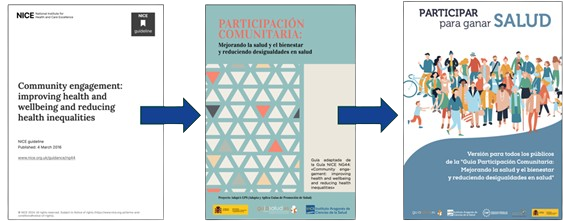



The EvaluA GPS project has its origin in a previous initiative, the AdaptA GPS project, “Adapt and Apply Health Promotion Guidelines”, which involved adapting the NG44 guideline of the United Kingdom’s National Institute for Health and Care Excellence (NICE) to the Spanish context. This guideline focuses on how to improve community participation based on available evidence. AdaptA GPS was carried out between 2017 and 2018, with the participation of 80 people organized into 10 working nodes from 10 autonomous communities: Andalusia, Aragon, Asturias, Catalonia, the Community of Madrid, the Valencian Community, Extremadura, the Balearic Islands, La Rioja, and the Region of Murcia.
As a result of this process, the new Clinical Practice Guideline on Community Participation—“Community Participation: Improving Health and Well-being and Reducing Health Inequalities. AdaptA GPS Project”—has been available since 2018 in the GuíaSalud Catalogue of the Ministry of Health. Alongside this guideline, an adapted version aimed at the general public was also developed. The project was promoted by the Directorate-General of Public Health of the Generalitat Valenciana, with the support of the Community Health Alliance, and benefited from methodological support from GuíaSalud of the Ministry of Health and the Aragon Health Sciences Institute. For the citizen-oriented version, collaboration took place with the Spanish Federation of Municipalities and Provinces (FEMP) and the Spanish Network of Healthy Cities (RECS).
In Aragon, the group responsible for the process was the Aragonese Primary Care Research Group (GAIAP) of the Aragon Institute of Health Research (IIS Aragón), together with the Community Care Strategy of the Aragon Health System’s Primary Care services.